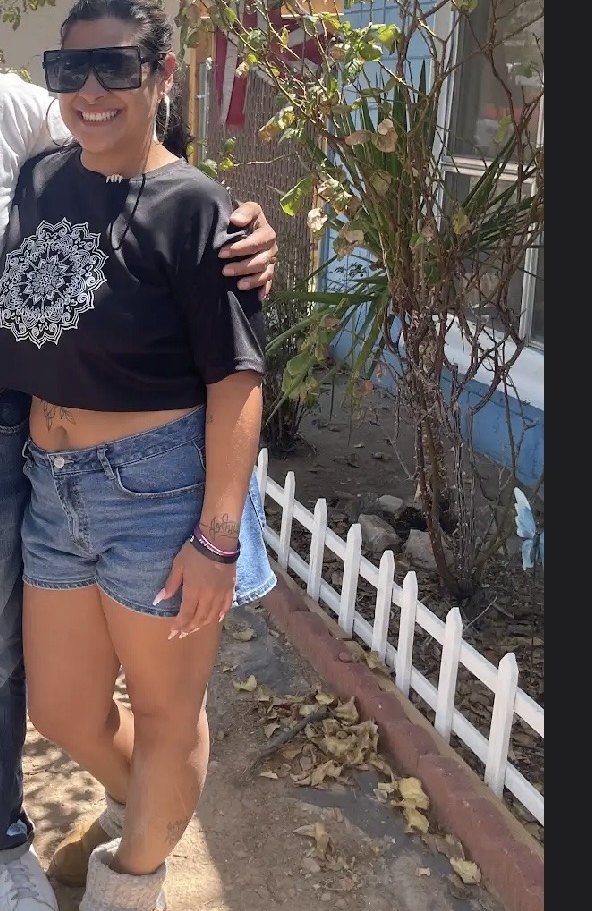
 Before
 After
Lindsay J.
“I've lost more than 1/2 my body weight.”
All articles
Reading time:
11 mins
Weight loss

Not every pound lost is fat. In the SURMOUNT-1 body scan substudy, people on tirzepatide lost 21.3% of their body weight, 33.9% of their fat mass and 10.9% of their lean mass over 72 weeks. Roughly 75% of the weight they lost was fat and 25% was lean mass (3).
Lean mass isn't only muscle, since it also includes water, organs and other tissue that isn't fat.
Here's the interesting part. The placebo group lost weight in almost the same ratio, about 75% fat to 25% lean, just far less of it (3). So the split looked like ordinary weight loss, only bigger.
Why does this matter for before and after pictures? Two people can lose the same number of pounds and look quite different, because body composition shapes how your clothes fit and how your outline changes. The substudy was small, though, and DXA has limits, so treat these figures as a guide rather than a forecast (3).
Protein and strength training are common topics to raise with your provider. Here's more on protein on GLP-1 medications.
Wondering whether Zepbound fits your health history? You can check your eligibility through Mochi Health.
Some of the biggest Zepbound changes never show up in a photo. In the 72-week trial, systolic blood pressure, the top number, fell an average of 6.6 to 7.7 mmHg across doses, versus 1.0 mmHg on placebo. HDL, often called "good" cholesterol, rose 6.9% to 9.2%, while it dipped 0.7% on placebo (2).
Non-HDL cholesterol fell 8.0% to 11.7% on tirzepatide versus 2.3% on placebo (2). The SURMOUNT-1 researchers reported improvements in every cardiometabolic measure they had planned to track (1).
The longer view adds more. SURMOUNT-1 followed 1,032 participants who also had prediabetes for 176 weeks, a little over three years. Those on tirzepatide had lost 12.3% to 19.7% of their body weight, versus 1.3% on placebo. Type 2 diabetes was diagnosed in 1.3% of the tirzepatide groups and 13.3% of the placebo group (5).
Zepbound's approved uses are weight management and obstructive sleep apnea in adults with obesity (2), not diabetes prevention. But these numbers show how much can change below the surface. Ask your provider which of your health numbers are worth watching.
Zepbound before and after pictures, whether they’re the member photos above or before and after Zepbound posts you find online, capture real moments in real people’s lives. They’re also snapshots. A photo pair can’t show you someone’s dose, health history or how long they’ve been on treatment, and small things like lighting and posture change how a body looks on camera.
When you look at any before and after photo, including your own, keep these in mind:
Lighting. Overhead light deepens shadows. Soft light from the front smooths them out.
Posture. A relaxed slouch versus standing tall with your stomach pulled in.
Angle and distance. A camera held low or close distorts proportions.
Clothing and timing. Loose clothes after dinner versus fitted clothes first thing in the morning.
Selection. The photos people choose to share are often their proudest moments. Smaller, steady changes count too.
Editing. Filters and cropping can change how a photo looks.
The trials show how wide the real range is. Even at the 15 mg dose, 9% of participants didn't reach a 5% loss, while 57% lost 20% or more (1). Researchers also note that the time it takes to reach a weight plateau differs from person to person (4).
So enjoy other people’s progress for what it is: encouragement. For a fair comparison, measure against your own starting point. The next section shows you how.
If you want Zepbound before and after pics that actually mean something, standardize them. The goal is simple: make the medication and your habits the only things that change between shots. A few steps do most of the work, and they take about two minutes each time.
Pick one spot. Use the same plain wall, in the same room, every time.
Fix your light. Face a window or the same lamp, and shoot at the same time of day.
Lock the camera position. Set your phone on a shelf or tripod at chest height. Mark where you stand with a strip of tape on the floor. Use the timer, not a mirror selfie.
Wear the same outfit. Fitted clothes show shape changes better than loose ones.
Stand the same way. Feet hip-width apart, arms relaxed at your sides, breathing normally. Don't suck in. Take a front, side and back photo.
Keep a steady schedule. Every four weeks is plenty. Photos taken days apart make real change hard to see.
Store them privately. Save each set in one folder, labeled with the date.
Then resist the urge to compare week one with week two. Line up month one with month four instead.
Photos show shape. Numbers show the trend, and that's what you and your provider need to see over time. Pairing your Zepbound before and after photos with a few simple measurements gives you a much clearer picture of real change.
For your waist, the National Heart, Lung, and Blood Institute suggests you stand, place a tape measure around your middle just above your hipbones, and read it just after you breathe out (7). Use the same tape and the same spot each time.
What to track | How often | Why it helps |
|---|---|---|
Weight | Once a week, same morning routine | Shows your trend instead of daily swings |
Waist | Every two to four weeks | Matches what the trials measured (2,7) |
Photos | Every four weeks | Captures changes in shape |
How your clothes fit | Anytime | A quick, low-tech check |
Appetite, energy and side effects | Weekly notes | Gives your provider useful context |
If the scale stalls for a few weeks, don't panic. Your waist or your clothes may still be changing. Here's more on why GLP-1 plateaus happen.
Bring your log to appointments, because it turns a vague hunch into something you and your provider can actually look at together.
The "after" in a photo isn't permanent by default. In SURMOUNT-4, a 2024 trial, 670 adults first lost an average of 20.9% of their weight over 36 weeks on tirzepatide. Those switched to placebo regained 14.0% over the next 52 weeks, while those who kept taking tirzepatide lost another 5.5% (6).
By week 88, 89.5% of people who stayed on tirzepatide had kept at least 80% of their initial weight loss. Only 16.6% of those switched to placebo did (6).
Zepbound is approved to help maintain weight reduction long term (2). Any change to your treatment, including stopping, is a decision to make with your provider first.
Here's more on stopping tirzepatide and what the research shows.
Zepbound is FDA-approved to reduce excess body weight and maintain weight reduction long term in adults with obesity, or with overweight and at least one weight-related condition. It's also approved to treat moderate to severe obstructive sleep apnea in adults with obesity. Both uses go alongside a reduced-calorie diet and more physical activity (2).
Affiliated Mochi Medical providers can prescribe FDA-approved brand-name tirzepatide (Zepbound), as well as compounded tirzepatide when appropriate. Compounded medications are not approved or evaluated by the FDA for safety, effectiveness, or quality. Compounded tirzepatide isn't the same product as Zepbound, and every trial result in this article comes from studies of the manufacturer's tirzepatide, not compounded versions.
Zepbound has a boxed warning for risk of thyroid C-cell tumors. In rats, tirzepatide caused thyroid C-cell tumors. It is unknown whether Zepbound causes these tumors, including medullary thyroid carcinoma (MTC), in humans (2). You shouldn't use Zepbound if you or a family member has had MTC, or if you have Multiple Endocrine Neoplasia syndrome type 2 (MEN 2) (2). A provider will discuss this with you.
Common side effects include nausea, diarrhea, vomiting, constipation, stomach pain, indigestion, injection site reactions, tiredness and hair loss (2). Zepbound may harm an unborn baby. If you use birth control pills, the label advises switching to a non-oral method or adding a barrier method for four weeks after starting and after each dose increase (2). Read more about Zepbound side effects.
Zepbound before and after results are best measured, not eyeballed. In SURMOUNT-1, average weight loss reached 15.0% to 20.9% at 72 weeks, waistlines shrank, blood pressure fell and HDL cholesterol rose (1,2). About a quarter of the weight lost was lean mass (3).
Online photos skip all of that. Your own photos, taken the same way every time, plus a tape measure and a weekly weight trend, tell a truer story.
Talk with a provider about whether Zepbound or another option suits you. You can check your eligibility through Mochi Health.
There isn't a reliable first-month number to give you. The first four weeks use the 2.5 mg starting dose, which is meant for getting started, not as a maintenance dose (2). In one SURMOUNT-1 analysis, 82% of participants who took most of their doses had lost 5% or more by week 12 (4). Others took longer.
It depends on your starting weight, your dose and your body. For someone starting at 231 pounds, 20 pounds is under 9% of body weight. In SURMOUNT-1, average losses reached 15.0% to 20.9% by week 72, but the pace varied widely from person to person (1,4). Your provider can help you set realistic milestones.
No medication targets one spot. Still, in a SURMOUNT-1 substudy, estimated visceral fat fell 40.1% with tirzepatide versus 7.3% with placebo (3). Average waist size shrank 14.0 to 18.5 cm across doses in the main trial (2).
Many are genuine, but they're hand-picked, and lighting, posture and camera angle change how bodies look. They also can't show dose, timeline or health history. Trial data gives you a more reliable picture of what tends to happen (1).
Jastreboff AM, Aronne LJ, Ahmad NN, et al. Tirzepatide Once Weekly for the Treatment of Obesity. New England Journal of Medicine. 2022;387(3):205-216. doi:10.1056/NEJMoa2206038. PMID: 35658024. https://pubmed.ncbi.nlm.nih.gov/35658024/
Eli Lilly and Company. ZEPBOUND (tirzepatide) injection, for subcutaneous use: Prescribing Information. DailyMed, U.S. National Library of Medicine. 2026. https://dailymed.nlm.nih.gov/dailymed/drugInfo.cfm?setid=487cd7e7-434c-4925-99fa-aa80b1cc776b
Look M, Dunn JP, Kushner RF, et al. Body composition changes during weight reduction with tirzepatide in the SURMOUNT-1 study of adults with obesity or overweight. Diabetes, Obesity and Metabolism. 2025;27(5):2720-2729. doi:10.1111/dom.16275. PMID: 39996356. PMCID: PMC11965027. https://pmc.ncbi.nlm.nih.gov/articles/PMC11965027/
Ard J, Lee CJ, Gudzune K, et al. Weight reduction over time in tirzepatide-treated participants by early weight loss response: Post hoc analysis in SURMOUNT-1. Diabetes, Obesity and Metabolism. 2025;27(9):5064-5071. doi:10.1111/dom.16554. PMID: 40677091. PMCID: PMC12326891. https://pmc.ncbi.nlm.nih.gov/articles/PMC12326891/
Jastreboff AM, le Roux CW, Stefanski A, et al. Tirzepatide for Obesity Treatment and Diabetes Prevention. New England Journal of Medicine. 2025;392(10):958-971. doi:10.1056/NEJMoa2410819. PMID: 39536238. https://pubmed.ncbi.nlm.nih.gov/39536238/
Aronne LJ, Sattar N, Horn DB, et al. Continued Treatment With Tirzepatide for Maintenance of Weight Reduction in Adults With Obesity: The SURMOUNT-4 Randomized Clinical Trial. JAMA. 2024;331(1):38-48. doi:10.1001/jama.2023.24945. PMID: 38078870. PMCID: PMC10714284. https://pmc.ncbi.nlm.nih.gov/articles/PMC10714284/
National Heart, Lung, and Blood Institute. Aim for a Healthy Weight: Assess Your Risk. National Institutes of Health. Accessed November 19, 2026. https://www.nhlbi.nih.gov/health/educational/lose_wt/risk.htm
This article is for informational purposes only and does not constitute medical advice. Always consult with a qualified healthcare provider before starting, stopping, or changing any medication or treatment plan. Zepbound (tirzepatide) and compounded tirzepatide require a written prescription from a licensed provider. Speak with a provider to determine if Zepbound or compounded tirzepatide is appropriate for you. Zepbound is FDA-approved, alongside a reduced-calorie diet and increased physical activity, to reduce excess body weight and maintain weight reduction long term in adults with obesity, or with overweight and at least one weight-related condition, and to treat moderate to severe obstructive sleep apnea in adults with obesity. Zepbound has a boxed warning for risk of thyroid C-cell tumors that a provider will discuss with you. Compounded medications are not approved or evaluated by the FDA for safety, effectiveness, or quality. Individual results are not guaranteed and may vary from person to person. All professional medical services are provided by licensed physicians and clinicians affiliated with independently owned and operated professional practices. Mochi Health Corp. provides administrative and technology services to affiliated medical practices it supports, and does not provide any professional medical services itself.
Share this post
Weight loss
More articles