All articles
Melasma Mustache: Why It Appears on the Upper Lip and What Research Says About Treating It
Reading time:
8 min

Skincare
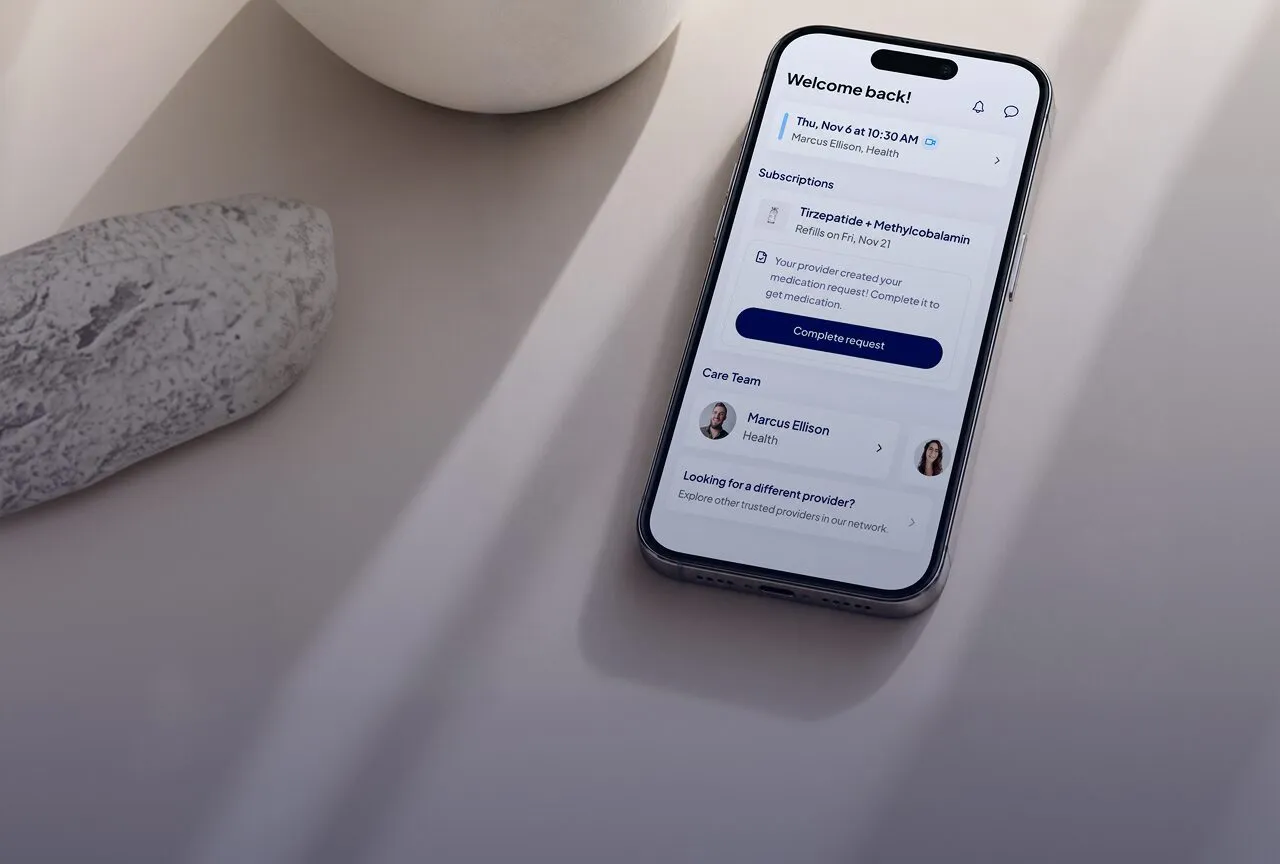
Get expert guidance and a personalized care plan designed around you.
Hair Removal Can Make It Worse
The upper lip is often the one melasma site that people also wax, thread, and bleach. Anything that inflames your skin can set off post-inflammatory hyperpigmentation, which can darken the melasma you already have (1).
So if your melasma patch darkens the week after an upper lip wax, that is not your imagination. It also does not mean the wax stripped off something protective. Inflammation can simply be one more pigment trigger, stacked on top of the light and your hormones (1).
This is worth raising with a provider before you change a routine you have kept for years. They can walk you through which hair removal methods irritate your upper lip the least, and how to time them around a treatment cream.
The Hydroquinone Product With FDA Approval
Hydroquinone blocks tyrosinase, the enzyme that sets the pace for melanin production (1). Block the enzyme, slow the pigment. That is why it has been the workhorse lightening ingredient for decades.
The regulatory situation is stranger than you would expect. Tri-Luma, which combines fluocinolone acetonide, hydroquinone, and tretinoin, is the only FDA-approved drug containing hydroquinone (3), and covers short-term treatment of moderate to severe facial melasma only and calls for sun avoidance and sunscreen use during treatment (2).
The FDA has received reports of skin rashes, facial swelling, and ochronosis, a blue-black staining of the skin, from hydroquinone lightening products (3).
Compounded Creams
An evidence-based review found triple combination cream and hydroquinone monotherapy to be the most effective and best-studied treatments for melasma (4). Triple combination means hydroquinone, tretinoin, and a corticosteroid in a cream together.
This review did not evaluate the compounded formulations described below, and none of them contains a corticosteroid.
Compounded medications for melasma are accessible through the Mochi platform, prescribed at a provider’s discretion. They include a hydroquinone and kojic acid cream with tretinoin, a hydroquinone spot treatment, and a niacinamide and tretinoin cream. Compounded medications are not approved or evaluated by the FDA for safety, effectiveness, or quality. Medications are filled and distributed by independently owned and licensed pharmacies.
Approach | What the evidence says | Regulatory status |
|---|---|---|
Triple combination cream | One of the two most effective and best-studied treatments in an evidence-based review (4) | Tri-Luma is FDA-approved, short-term use (2) |
Hydroquinone alone | Ranked equal to triple combination cream in the same review (4) | Prescription only; No FDA-approved standalone product (3) |
Compounded hydroquinone creams | Not separately studied in clinical trials | Not FDA-approved (3) |
Tinted sunscreen with iron oxides | Reduced contrast over 5 months in 42 women (5); no significant difference from untinted sunscreen on clinician-scored severity (5) | Cosmetic, available over the counter |
Ready to see whether prescription skincare fits your situation? You can check your eligibility in a few minutes.
Tinted Sunscreen Outperforms Clear Sunscreen
If visible light drives part of the pigment change in melasma, you need something that physically blocks visible light. Iron oxides and pigmentary titanium dioxide do that work, and they are what make a sunscreen look beige instead of white.
One randomized, investigator-blinded study followed 42 women with melasma through five summer months (5). Half applied a tinted sunscreen with iron oxides and pigmentary titanium dioxide at least twice daily. Half used an untinted one. The contrast between affected and unaffected skin dropped significantly in the tinted group, and did not change significantly in the untinted group (5). Clinician-scored severity improved in both groups, with no significant difference between them, so the tinted advantage showed up in measured color contrast rather than in overall severity scores (5).
A second trial, this one double-blind, followed 68 patients for eight weeks (6). It compared a sunscreen covering UV plus visible light against one covering UV alone, both at high SPF. Everyone in that trial used 4 percent hydroquinone rather than a compounded cream, and the broader sunscreen improved how well it worked, which suggests the cream and the photoprotection are doing two different jobs for your skin.
Who Should Not Use These Creams
Tretinoin is a retinoid, and retinoids are not recommended during pregnancy or while you are trying to conceive. This lands harder for melasma than for almost any other condition, because pregnancy is one of the main things that brings melasma on in the first place (1). If you are pregnant, breastfeeding, or planning to be, say so before anything gets prescribed.
The Tri-Luma label carries its own warnings, tied to both the steroid and the hydroquinone, and the approval is for short-term rather than open-ended use (2). Long, unsupervised hydroquinone use is exactly the setting where ochronosis has been reported (3).
Sensitivity to any ingredient rules a formula out, and plain irritation is the most common complaint with hydroquinone.
Signs That Need a Provider
Some things are not melasma, and a lightening cream will not touch them. A dark patch on just one side of the upper lip deserves a review by your provider. So does any pigmented spot that is changing shape, growing, bleeding, crusting, or developing a ragged border.
If a prescription cream leaves your skin red, swollen, blistered, or burning, do not push through it. Get advice promptly, and ask your prescriber whether to keep going.
Pigment that showed up abruptly, with no pregnancy, no new contraceptive, and no sun exposure to explain it, is worth investigating rather than covering up. Several other conditions darken an upper lip, and a provider can tell them apart.
Steps to Take Before Your First Appointment
Photograph the patch in the same daylight each time, because pigment shifts slowly and your memory makes a terrible baseline.
Note when you first saw it, and whether it lined up with a pregnancy, a new contraceptive, or a change in medication.
List everything already touching that area, including hair removal products, whitening toothpaste, and scented lip balm.
Switch to a tinted broad-spectrum sunscreen containing iron oxides, which is a step you can take without a prescription (5,6).
Ask whether the cream you are offered is FDA-approved or compounded, because the answer changes what has been reviewed about it (3).
The Bottom Line
A melasma mustache is a pigment problem in the shape of facial hair, which is why covering it never quite satisfies. Protection from light matters as much as anything you put on your skin. Progress is slow, and a relapse is part of the condition rather than a sign that you failed at it. A provider can tell you whether a prescription is appropriate, and you can check your eligibility to start that conversation.
FAQs
What causes melasma on the mustache area?
The same things that cause it anywhere else: ultraviolet light, visible light, sex hormones, and a genetic predisposition (1). Your upper lip is simply one of the most exposed parts of the central face, so it tends to show the change early.
What kind of cream can I use to treat a melasma mustache?
Providers canprescribe hydroquinone on its own or paired with a retinoid. An evidence-based review found hydroquinone alone to be one of the most effective and best-studied treatments(4). Tri-Luma is the only FDA-approved hydroquinone product for facial melasma, and compounded alternatives are not FDA-approved (2,3).
How do you cover melasma on the upper lip?
Covering it is cosmetic rather than treatment, and color-correcting makeup is the usual route. A tinted sunscreen with iron oxides does both jobs at once, since the pigment that gives you coverage also blocks visible light (5).
What triggers melasma to worsen?
Sun and visible light exposure, hormonal changes like pregnancy or hormonal contraception, and inflammation of the skin (1). Anything that irritates your upper lip, waxing included, can darken existing pigment through a post-inflammatory response (1).
References
Ogbechie-Godec OA, Elbuluk N. Melasma: an up-to-date comprehensive review. Dermatology and Therapy, 2017.
US Food and Drug Administration. TRI-LUMA cream prescribing information, 2014.
US Food and Drug Administration. Skin lightening product safety (content current as of May 2026).
McKesey J, Tovar-Garza A, Pandya AG. Melasma treatment: an evidence-based review. American Journal of Clinical Dermatology, 2020; 21(2):173-225.
Polena H, Queille-Roussel C, Graizeau C, Duteil L, Sayag M, Passeron T. Comparison of visible light-protective tinted sunscreen to untinted sunscreen to protect melasma patients during summer: a prospective randomized investigator-blinded study. Journal of Cosmetic Dermatology, 2025.
Castanedo-Cazares JP, Hernandez-Blanco D, Carlos-Ortega B, et al. Near-visible light and UV photoprotection in the treatment of melasma: a double-blind randomized trial. Photodermatology, Photoimmunology and Photomedicine, 2014.
Regazzetti C, Sormani L, Debayle D, et al. Melanocytes sense blue light and regulate pigmentation through opsin-3. Journal of Investigative Dermatology, 2018; 138(1):171-178.
US Food and Drug Administration. FDA works to protect consumers from potentially harmful OTC skin lightening products. Drug Safety Communication, April 19, 2022.
This article is for informational purposes only and does not constitute medical advice. Always consult with a qualified healthcare provider before starting, stopping, or changing any medication or treatment plan. Compounded hydroquinone, kojic acid, and tretinoin cream, compounded hydroquinone spot treatment, compounded niacinamide and tretinoin cream, and tretinoin require a written prescription from a licensed provider. Speak with a provider to determine if compounded hydroquinone cream or tretinoin is appropriate for you. Tri-Luma is the only FDA-approved prescription product containing hydroquinone and is approved for the short-term treatment of moderate to severe melasma of the face, and the compounded creams described here are not FDA-approved. Compounded medications are not approved or evaluated by the FDA for safety, effectiveness, or quality. Individual results are not guaranteed and may vary from person to person. Medications are filled and distributed by independently owned and licensed pharmacies. All professional medical services are provided by licensed physicians and clinicians affiliated with independently owned and operated professional practices. Mochi Health Corp. provides administrative and technology services to affiliated medical practices it supports, and does not provide any professional medical services itself.
Share this post
Skincare
More articles