All articles
Hydroquinone and Tretinoin for Dark Spots: Uses and Cautions
Reading time:
7 mins

Skincare

Get expert guidance and a personalized care plan designed around you.
How This Cream's Strengths Compare With Tri-Luma
The compounded cream described here contains 12% hydroquinone, compared with 4% in Tri-Luma, the FDA-approved hydroquinone cream (1,2). The published trials cited in this article tested hydroquinone at 4% or lower, so their results describe those strengths rather than this cream specifically. A provider chooses a strength based on your skin tone, your condition, and your history of irritation. The label warnings below come from Tri-Luma, which contains 4% hydroquinone, and a provider tailors them to the strength prescribed.
Each ingredient also carries a different regulatory status, which the table below sets out.
Ingredient | Amount in this cream | Reference point |
|---|---|---|
Hydroquinone | 12% | Tri-Luma contains 4% (2) |
Tretinoin | 0.025% | Tri-Luma contains 0.05% (2,4) |
Kojic acid | 3% | The trial above used 1% (5) |
Niacinamide | 2% | The trial above used 4% (6) |
Because a licensed pharmacy compounds the cream for each prescription, FDA has not reviewed the finished product for safety or quality.
Hydroquinone Is Now Available in the US by Prescription
Until 2020, drugstores sold low-strength hydroquinone creams without a prescription. The CARES Act changed the rules for those drugs that year. FDA now states that no over-the-counter skin lightening product with hydroquinone is legally marketed in the US (1). Sellers were expected to stop distributing these products after September 2020, and FDA sent warning letters in 2022 to 12 companies that were still selling them (1).
That change is why hydroquinone now requires a prescription, and why creams sold online without one call for caution. FDA testing has also found mercury in some imported skin lighteners, which is a separate and serious hazard (1). A separate hydroquinone spot treatment is also available through Mochi Health, and an affiliated Mochi Medical provider can explain how the two formulas differ.
Most Listed Reactions Happen Where the Cream Is Applied
The labels for hydroquinone and tretinoin mostly list side effects that happen where the cream is applied. The Tri-Luma label lists burning, itching, irritation, and dryness, while the tretinoin label adds redness, peeling, stinging, and sun sensitivity (2,4).
Allergic contact dermatitis, an itchy, inflamed rash caused by an allergy to one of the ingredients, is also listed on the Tri-Luma label (2). Hydroquinone can lighten normal skin around a spot as well (2). The label states that excess bleaching cannot be ruled out in people with the deepest skin tones (2). If any of these reactions appear, contact your prescriber, who can assess whether your treatment needs adjusting.
The Tri-Luma Label Advises Watching for Ochronosis
Exogenous ochronosis is a gradual blue-black darkening of the skin linked to hydroquinone, and the Tri-Luma label states that it is a reason to stop treatment (2). Contact your prescriber right away if you notice it. The label notes that most reported cases have been in Black patients, although the condition has also been reported in white and Hispanic patients (2). Published case reports describe it after prolonged use, including one involving a 2% cream (7).
Ochronosis can be difficult to treat once it develops, which is why regular follow-up with your provider matters. Tri-Luma is labeled for short-term use rather than ongoing upkeep, and your provider can set check-ins to see how your skin responds (2).
Daily Sunscreen Is Part of the Treatment
Ultraviolet light drives pigment production, and tretinoin makes skin more sensitive to sunlight, so sun protection is part of the treatment rather than an optional extra (4). The Tri-Luma label pairs treatment with daily SPF 30 sunscreen (2). The Cleveland Clinic also advises avoiding sun lamps and tanning beds while using hydroquinone (8).
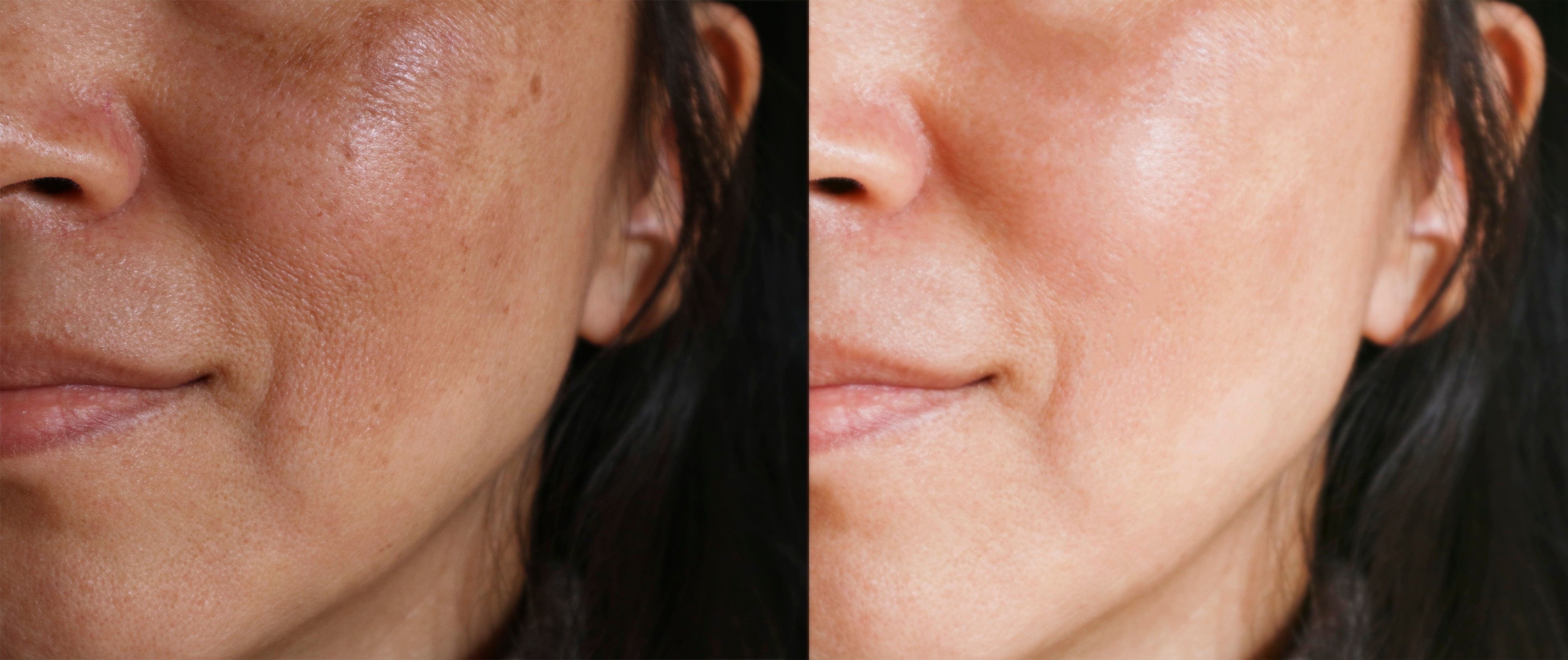
The Tri-Luma trials ran for eight weeks, and the label notes that melasma usually returns once treatment stops (2,3). A provider can talk through a longer-term plan with you. Pigment on the upper lip, sometimes called a melasma mustache, is one place where melasma can appear.
Share Your Pregnancy Plans, Allergies, and Skin History First
Tretinoin can harm a developing baby, and the Tri-Luma label states that it may cause the death of the baby before birth, changes in the baby's growth, and birth defects (2). Some tretinoin labels say the cream should not be used during pregnancy at all (4). Tell your provider if you are pregnant, trying to conceive, or breastfeeding.
A combination cream is also not recommended for anyone with a known allergy to hydroquinone, tretinoin, or other ingredients in the formula (2). Caution matters if you have eczema (dry, itchy, inflamed skin), rosacea (a condition that causes facial redness), or very sensitive skin. The tretinoin label also warns about combining it with harsh products such as salicylic acid, sulfur, or resorcinol (4). Avoid applying the cream to sunburned or broken skin, since the Cleveland Clinic lists both as places the medication should not go (8).
Steps to Take Before Your First Application
These steps do not replace your prescriber's instructions, although they make the first few weeks easier to manage.
Tell your provider about pregnancy plans, allergies, and every product you already use on your face, since harsh actives can add to irritation.
Follow the directions on your prescription label, which for Tri-Luma means a thin film once daily at least 30 minutes before bedtime (2).
Wash your hands before and after applying the cream, and keep it away from your eyes, mouth, and the creases of your nose (4,8).
Apply broad-spectrum sunscreen (one that protects against both UVA and UVB rays) every morning, and reapply it when you spend time outdoors (2,8).
Take a photo in the same light every two weeks, because gradual change is hard to judge in a mirror.
Book a follow-up before your refill so that a provider can review how your skin has responded.
Check your eligibility to see whether prescription skincare through Mochi Health is a fit for you.
Some Reactions Need a Provider's Attention the Same Day
The tretinoin label describes redness and peeling as common, but several other symptoms are different and should not wait (4). Seek care promptly for hives or for swelling of the face, lips, tongue, or throat, which can signal an allergic reaction (8). Contact your prescriber quickly about blistering, crusting, severe burning, or swelling of treated skin, and about any blue-black or gray darkening in the treated area (2,8).
Your prescriber can decide whether to continue the cream, change it, or pause it while your skin recovers. Keep a note of when a reaction started and which other products you used that day, because that detail helps a provider tell irritation apart from allergy.
The Bottom Line
The compounded hydroquinone combination cream available through Mochi Health puts hydroquinone, tretinoin, kojic acid, and niacinamide, four ingredients studied for pigment, into a single step (2,3,5,6). Concentration, skin tone, sun habits, and pregnancy plans all shape what a provider recommends, so bring all four to the visit. Mochi skincare and melasma treatment options set out related choices. Check your eligibility to start a visit.
FAQs
Can I Use Tretinoin Cream and Hydroquinone Together?
You can use tretinoin cream and hydroquinone together when a provider prescribes them that way. The pairing is the basis of Tri-Luma, the only FDA-approved hydroquinone product (1,2).
Is It Safe to Use Hydroquinone With Tretinoin?
Whether it is safe to use hydroquinone with tretinoin depends on your skin, your pregnancy plans, and the strength prescribed. The Tri-Luma label warns about irritation, allergic reactions, and ochronosis, which a provider weighs against your history (2).
Do You Apply Hydroquinone Before or After Retinol?
Whether you apply hydroquinone before or after retinol, an over-the-counter relative of tretinoin, depends on your products, so your prescriber's directions come first. When both are in one cream, a single thin layer goes on once daily as labeled (2). With separate products, ask your provider about order and timing.
Why Are People Quitting Tretinoin?
People who stop tretinoin often mention irritation, since the label lists redness, peeling, stinging, and sun sensitivity (4). Others stop early, since the label notes that acne results may take six weeks or more (4). Contact your prescriber before making any change, since a different strength or schedule may help.
References
US Food and Drug Administration. FDA works to protect consumers from potentially harmful OTC skin lightening products. Drug safety communication, 2022. FDA skin lightening update
TRI-LUMA (fluocinolone acetonide, hydroquinone, and tretinoin) cream, 0.01%/4%/0.05%. Prescribing information. DailyMed, US National Library of Medicine. Initial US approval 2002. Tri-Luma prescribing information
Taylor SC, Torok H, et al. Efficacy and safety of a new triple-combination agent for the treatment of facial melasma. Cutis, 2003. Pooled analysis of two randomized, investigator-blind trials. triple-combination melasma trials
Tretinoin Cream USP, 0.025%. Prescribing information. DailyMed, US National Library of Medicine. dailymed.nlm.nih.gov/dailymed/drugInfo.cfm?setid=b5e385a2-f6f9-41cb-8a33-eedba397043f
Deo KS, et al. Kojic acid vis-a-vis its combinations with hydroquinone and betamethasone valerate in melasma: a randomized, single blind, comparative study of efficacy and safety. Indian Journal of Dermatology, 2013. Randomized trial. pmc.ncbi.nlm.nih.gov/articles/PMC3726874/
Navarrete-Solís J, et al. A double-blind, randomized clinical trial of niacinamide 4% versus hydroquinone 4% in the treatment of melasma. Dermatology Research and Practice, 2011. Randomized split-face trial. pmc.ncbi.nlm.nih.gov/articles/PMC3142702/
Exogenous ochronosis after prolonged use of topical hydroquinone (2%) in a 50-year-old Indian female. Case report. pmc.ncbi.nlm.nih.gov/articles/PMC3482806/
Cleveland Clinic. Hydroquinone Cream: How to Apply and Side Effects. my.clevelandclinic.org/health/drugs/19764-hydroquinone-skin-cream-gel-emulsion-lotion-or-solution
This article is for informational purposes only and does not constitute medical advice. Always consult with a qualified healthcare provider before starting, stopping, or changing any medication or treatment plan. Compounded hydroquinone combination creams, Tri-Luma®, and tretinoin require a written prescription from a licensed provider. Speak with a provider to determine if a compounded hydroquinone combination cream, Tri-Luma®, or tretinoin is appropriate for you. Tri-Luma® is FDA approved for the short-term treatment of moderate to severe facial melasma and tretinoin is FDA approved for acne, while compounded hydroquinone, kojic acid, niacinamide, and tretinoin creams are not FDA approved and their use for dark spots and melasma is off-label. Compounded medications are not approved or evaluated by the FDA for safety, effectiveness, or quality. Individual results are not guaranteed and may vary from person to person. All professional medical services are provided by licensed physicians and clinicians affiliated with independently owned and operated professional practices. Mochi Health Corp. provides administrative and technology services to affiliated medical practices it supports, and does not provide any professional medical services itself.
Share this post
Skincare
More articles